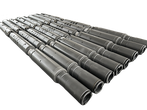
Hard formations like granite, quartzite, and limestone have extremely high compressive strengths typically over 20,000 psi. Drilling causes excessive vibrations, bit bouncing, and poor weight transfer as the string fails to adequately grip these dense walls. Key challenges include:
- Rapid dulling from abrasive formations eroding cutters. Stabilizers must be highly wear-resistant.
- Risk of sticking due to string being unable to slide smoothly along hard borehole surface. Stabilizers need good non-sticking properties.
- Difficult weight transfer on bit results in poor ROP and RPMS. Stabilizers must promote continuous efficient WOB transfer.
- Excess whirl causes aggressive collisions against the borehole. Stabilizers must dampen vibrations and stabilize drill pipe motions.
- Robust thick blades withstand extremely abrasive formations and prevent excessive wear or damage.
- Hardfacing coatings like tungsten carbide provide enhanced durability against erosion and abrasion.
- Special surface treatments reduce friction for reliable non-sticking performance.
- Reinforced one-piece design maintains consistent, reliable stabilization.
- Integral spiraled or straight blades optimized for lateral stiffness keep the string firmly centered.
- Properly spaced blades along the string mitigate whirl and lateral impacts.
Medium formations have compressive strengths between 5,000-15,000 psi. Shales, siltstones, and dolomite are common examples. Challenges when drilling medium-strength formations include:
- Borehole enlargement and poor wellbore quality if stabilizers inadequately support the walls.
- Increased risk of packed-hole conditions as fragmented cuttings accumulate around the string.
- Insufficient stabilization leads to lower weight transfer and penetration rates.
- Slightly flexible stabilizers allow some conformance to medium-strength walls while still providing stabilization.
- Replaceable blade designs enable economical restoration of worn blades downhole using pre-dressed replacements.
- Shorter modular construction provides more convenient handling and transportation.
- Cost-effective design tailored for less demanding medium formation environments.
- Semi-rigid stabilizers strike the optimal balance between stability and flexibility for medium formations.